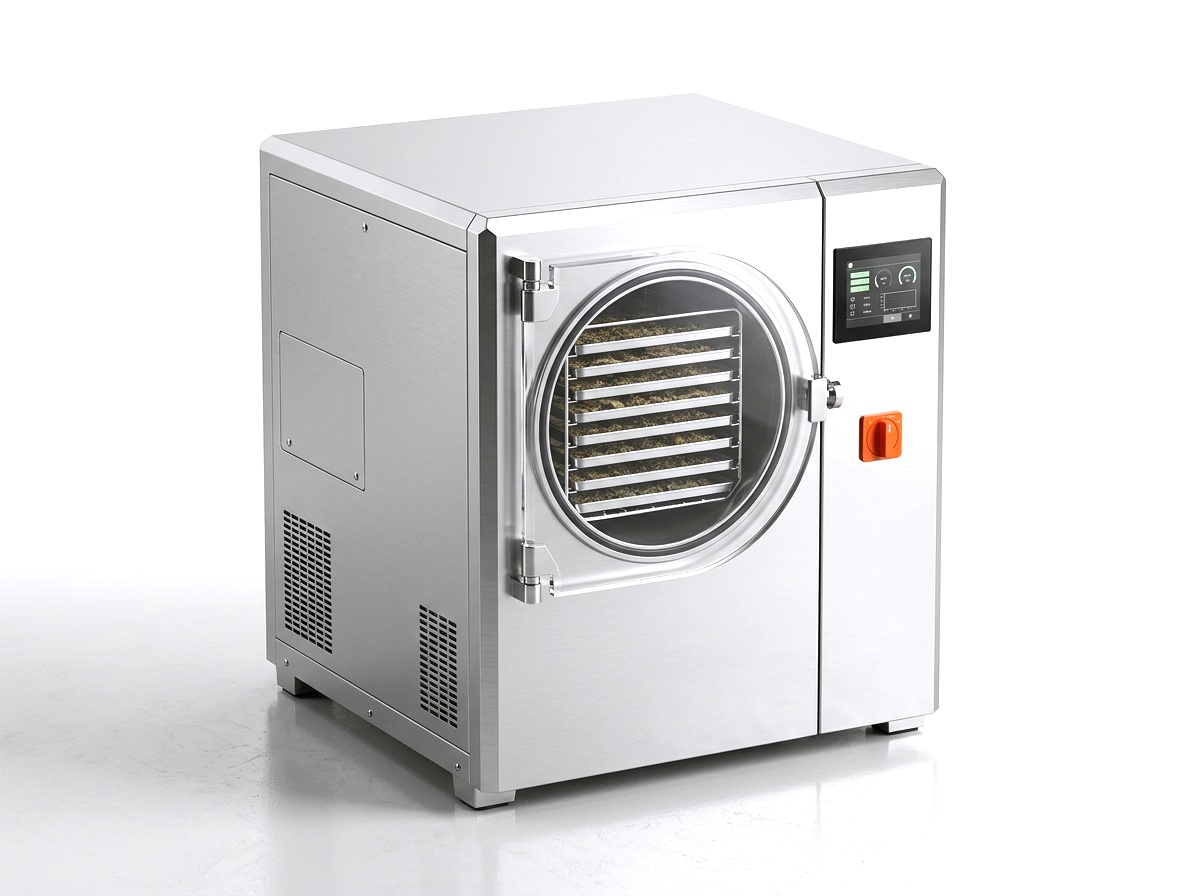
Closed-Loop Heat-Pump Botanical Dryer (BE-HV-03) vs. Open Hang-Drying Rooms: Terpene & Water Activity Control
Why open HVAC hang-drying rooms suffer from micro-climate mold pockets and terpene venting, and how closed-loop 20-55 C heat-pump dehumidification standardizes water activity (0.58 aw).
The Practical Reality & Process Physics
Traditional hang-drying rooms rely on oversized split AC units and portable dehumidifiers that cycle wildly in temperature and vent aromatic monoterpenes outdoors. Dense canopy racks trap stagnant humidity pockets (> 68% RH) where Botrytis and Aspergillus proliferate during the critical first 36 hours.
The BE-HV-03 Closed-Loop Heat-Pump Tray & Belt Botanical Dryer isolates the batch inside a sanitary insulated chamber. Warm air passes uniformly across perforated stainless trays, condenses moisture over the cold evaporator coil, and recycles latent heat back to the supply plenum at a gentle 20 C to 32 C.
Because the airflow loop is 100% sealed, zero facility odor escapes, energy consumption drops by 60% compared to vented electric heaters, and programmable multi-step RH curves bring flower to a uniform 0.58 water activity (11% moisture content) ready for BE-HV-01 trimming.
Reference Operating Window & Numbers
| Parameter | Specification |
|---|---|
| Temperature Envelope | 20 C - 55 C Programmable Closed-Loop |
| Relative Humidity Control | +/- 2% RH Stepped Dehydration Curve |
| Energy Consumption | 60% Lower kWh vs Vented Resistance Heaters |
| Odor & Bio-Security | 100% Sealed Zero-Exhaust Recirculation |
Step-by-Step: How to Do It Right on the Floor
Step 1: Define Your Material & Target Spec (Temperature Envelope: 20 C - 55 C Programmable Closed-Loop)
Before touching a machine switch, measure your starting material and target container or batch geometry. In this workflow, holding Temperature Envelope within 20 C - 55 C Programmable Closed-Loop is the difference between a repeatable commercial run and a batch you have to rework by hand. Log your viscosity, moisture content, or dimensional tolerance on a single batch sheet before warming up the line.
Step 2: Lock Your Thermal & Mechanical Envelope (Relative Humidity Control: +/- 2% RH Stepped Dehydration Curve)
Set your PID temperature controllers, pressure regulators, or screen clearances to stabilize at +/- 2% RH Stepped Dehydration Curve for at least 15 minutes before feeding product. Cold stainless steel steals heat from the first 50 units; letting the manifold or jacketed wall reach thermal equilibrium ensures unit #1 and unit #1,000 behave identically.
Step 3: Run a Dry & Wet Calibration Pass (Energy Consumption: 60% Lower kWh vs Vented Resistance Heaters)
Never launch a full shift blindly. Run a 10-unit or 5-liter calibration check at your target cadence (60% Lower kWh vs Vented Resistance Heaters), weigh the output on a 0.01 g analytical balance, and inspect seals, trichome integrity, or droplet dispersion under bright white light.
Step 4: Close the Loop Within the Critical Window (Odor & Bio-Security: 100% Sealed Zero-Exhaust Recirculation)
Complete downstream sealing, curing, filtration, or nitrogen packaging while your product is still inside the optimal physical window (100% Sealed Zero-Exhaust Recirculation). Clean contact parts immediately at shift end while residues are still warm so tomorrow's batch starts with zero cross-contamination.
Comparing All Your Options: What Exists & What Fits Your Scale
| Option / Approach | Realistic Daily Output | Where It Shines (Pros) | Where It Hurts (Limits & Trade-offs) | Who Should Choose This |
|---|---|---|---|---|
| Hand Scissors + Hang-Drying Room with Split AC | 5 - 15 kg dry flower / day | Maximum visual preservation for ultra-small craft batches. | Takes 12-15 trimmers per harvest; room humidity swings after day 3 cause mold inside dense colas or over-dry brittle buds. | Micro-cultivators harvesting under 30 kg per cycle with cheap local labor. |
| Neoprene Stem Bucker (BE-HV-02) + VFD Wet/Dry Tumbler Trimmer (BE-HV-01) + 4-Deck Grader (BE-HV-04) | 100 - 350 kg flower / day | Replaces 18 hand trimmers; variable drum speed protects trichome heads; sorts A-buds, mids, and extraction trim automatically. | Requires consistent 10-12% moisture target for dry trimming. | Commercial flower and pre-roll facilities processing 100 to 1,000 kg per harvest. |
| Closed-Loop Heat-Pump Botanical Dryer (BE-HV-03) + Low-RPM Screen Mill (BE-HV-05) | 200 - 600 kg wet input / batch | Condenses moisture at 20-32 C in a sealed loop so monoterpenes are never vented out a roof exhaust; delivers uniform 11% moisture for extraction. | Higher initial cost than hanging racks in a warehouse. | GMP medicinal flower producers and high-terpene extraction facilities. |
| Agricultural Decorticator + Bale Breaker + Hurd Air Classifier (Field Fiber Line) | 2,000 - 10,000 kg retted stalks / day | Crushes woody core (shive/hurd) and combs long bast fibers for non-woven mats, textiles, and biocomposites. | Zero overlap with floral/cannabinoid machinery; requires dry retted stalks (<14% moisture) in a dust-extracted barn. | Industrial fiber and hurd processors (we supply the floral/biomass side and advise you clearly so you never mix floral and bast-fiber lines). |
How to Decide: The 4 Critical Decision Points Before You Buy
1. Calculate Your Real Weekly Volume vs. Labor Cost
Do not buy automation for ego, and do not stay manual out of habit. If two operators spend more than 12 hours a week repeating this step by hand, or if scrap/giveaway exceeds 3%, semi-automatic or turnkey equipment pays for itself in 6 to 14 weeks.
2. Match the Machine to Your Hardest Material (20 C - 55 C Programmable Closed-Loop)
Anyone can run thin, warm liquids or bone-dry trim. Size and choose your equipment for your most demanding product — whether that is un-cut live rosin, sticky resinous flower, or -40 C solvent washes requiring +/- 2% RH Stepped Dehydration Curve.
3. Check Format Changeover Time Before You Buy
If your facility runs five different SKUs or strains a day, a rigid rotary line that takes 4 hours to re-tool will sit idle. Choose modular equipment where trays, screens, or fluid paths swap in under 15 minutes.
4. Demand Proof Before Shipment (Unedited 4K FAT)
Never wire final balance payments on brochure promises. Insist on seeing your exact hardware (BE-HV-03, BE-HV-04, BE-HV-01) running your device CAD and facility voltage in an unedited 4K test video before the crate leaves the factory.
Expensive Mistakes Operators Make (and How to Avoid Them)
Ignoring Thermal & Pressure Drift (Temperature Envelope)
Allowing Temperature Envelope to drift outside 20 C - 55 C Programmable Closed-Loop mid-shift causes immediate viscosity spikes, terpene evaporation, or seal failure. Always use closed-loop PID control rather than manual dial rheostats.
Buying Oversized or Undersized Upstream Prep
A fast machine starved by slow upstream prep — or bottlenecked by slow manual capping/drying downstream — never hits 60% Lower kWh vs Vented Resistance Heaters. Balance every step of the cell to the same hourly rhythm.
Skipping Rigid Tooling or Sanitary Connections
Using soft shipping foam, uncalibrated silicone hoses, or non-sanitary threads introduces +/- 2% RH Stepped Dehydration Curve alignment errors and microbial traps. Stick to 304/316L stainless steel and CNC-milled 6061-T6 aluminum fixtures.
Questions Buyers & Operators Ask Most
What temperature range should we program on BE-HV-03 to preserve volatile terpenes?
Run a stepped 20 C to 24 C curve with 55% -> 48% RH ramp for smokable flower and pre-roll feedstock; use 38 C to 50 C rapid drying for industrial hemp extraction biomass.
When should we stay manual vs. upgrading to BE-HV-03, BE-HV-04, BE-HV-01?
If you are running small R&D tests once a month, manual tools are fine. The moment you need repeatable 60% Lower kWh vs Vented Resistance Heaters output, consistent +/- 2% RH Stepped Dehydration Curve precision, and single-operator labor efficiency without batch-to-batch drift, upgrading to BE-HV-03, BE-HV-04, BE-HV-01 eliminates the bottleneck.
Can we buy just one machine now and add the rest of the line later?
Yes. Every module (BE-HV-03, BE-HV-04, BE-HV-01) is built to operate standalone on standard facility utilities (100% Sealed Zero-Exhaust Recirculation) while sharing the same 100-cavity tray geometry and sanitary Tri-Clamp standards when you scale.
If You Are Building This Line: Matched Modular Equipment
Only after your process and daily volume are clear should you pick hardware. Here are the modules engineered for this exact workflow.
| SKU | Machine | Throughput | 1-Unit (EUR) | Action |
|---|---|---|---|---|
| BE-HV-03 | Low-Temperature Heat-Pump Tray & Belt Botanical Dryer | 100 - 350 kg wet batch capacity | EUR 6,800 | Cart |
| BE-HV-04 | Multi-Tier Flower Size Sorter & Grade Classifier | 40 - 120 kg/hr | EUR 3,200 | Cart |
| BE-HV-01 | Commercial Wet & Dry Tumbler Bud Trimming Machine | 15 - 45 kg/hr (wet) / 4 - 12 kg/hr (dry) | EUR 2,800 | Cart |
What to Read Next
Wet vs. Dry Tumbler Bud Trimming & Stem Bucking Line: Preserving Flower Structure at Scale
How to sequence counter-rotating neoprene stem bucking (BE-HV-02), VFD tumbler trimming (BE-HV-01), and 4-tier size grading (BE-HV-04) so A-grade flower goes to jars and trim goes to pre-rolls.
Industrial Hemp & Cannabis Post-Harvest Processing Guide: Flower & Extraction Biomass vs. Stalk Fiber
Understanding the engineering boundary between trichome-preserving botanical flower/extraction post-harvest lines (BE-HV-01 to BE-HV-05) and agricultural stalk fiber decortication.
Sizing a Commercial Post-Harvest Line (kg/hr): Matching Stem Bucker, Tumbler Trimmer, Heat-Pump Dryer & Sorter
How to calculate wet-to-dry mass balance (4.5:1) so your bucking (BE-HV-02), trimming (BE-HV-01), drying (BE-HV-03), and sorting (BE-HV-04) machines never bottleneck harvest week.