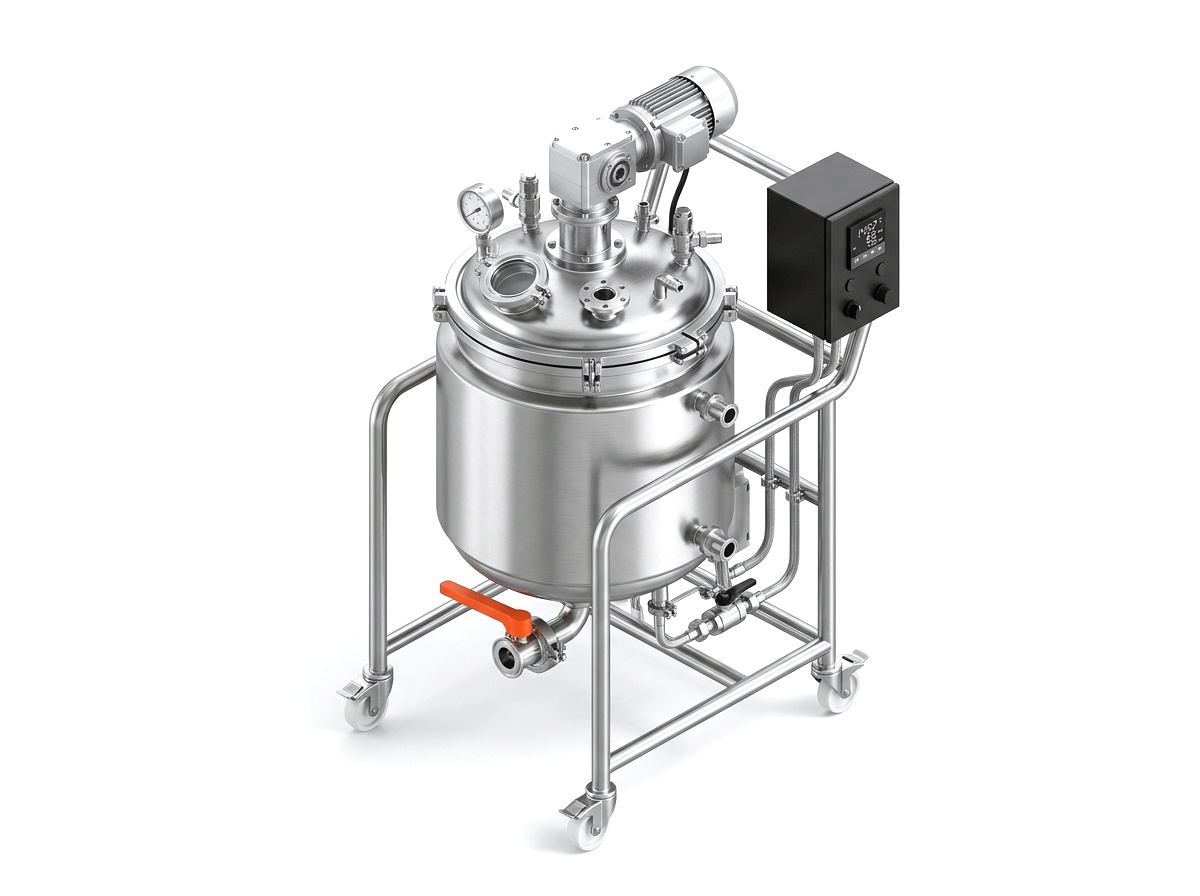
Jacketed 316L Decarboxylation Reactor (BE-LB-03) vs. 5-Shelf Vacuum Purge Ovens (BE-LB-05): Thermal Curves
When to use agitated jacketed reactors with condenser traps for bulk oil decarboxylation vs multi-shelf PID vacuum ovens for solvent purging and live rosin cold-curing.
The Practical Reality & Process Physics
Decarboxylating 20 kg to 80 kg of crude oleoresin or distillate precursor on open hotplates or shallow oven trays causes localized scorching at the bottom surface, uneven CO2 evolution foaming, and up to 35% loss of lighter sesquiterpenes to the exhaust duct.
In CELL-03, bulk decarboxylation takes place inside the BE-LB-03 50L/100L Jacketed 316L Stainless Reactor. Heated thermal fluid circulates through the outer jacket while a PTFE anchor agitator continuously sweeps the vessel wall at 110 C to 122 C, routing evolved vapours through an overhead shell-and-tube condenser so terpenes can be captured rather than vented.
Conversely, for high-viscosity slabs, shatter solvent purging, and solventless live rosin nucleation (CELL-04), the BE-LB-05 5-Shelf Digital PID Heated Vacuum Oven provides direct conductive shelf heating (+/- 0.5 C uniformity from 30 C to 120 C) without mechanical shear.
Reference Operating Window & Numbers
| Parameter | Specification |
|---|---|
| Jacketed Reactor Volume | 50L / 100L 316L Sanitary Stainless |
| Decarb Temp & Vacuum | 105 C - 125 C under Closed Condenser |
| 5-Shelf Vacuum Oven | +/- 0.5 C PID Shelf Uniformity |
| Terpene Condenser | Closed-Loop Volatile Recovery Trap |
Step-by-Step: How to Do It Right on the Floor
Step 1: Define Your Material & Target Spec (Jacketed Reactor Volume: 50L / 100L 316L Sanitary Stainless)
Before touching a machine switch, measure your starting material and target container or batch geometry. In this workflow, holding Jacketed Reactor Volume within 50L / 100L 316L Sanitary Stainless is the difference between a repeatable commercial run and a batch you have to rework by hand. Log your viscosity, moisture content, or dimensional tolerance on a single batch sheet before warming up the line.
Step 2: Lock Your Thermal & Mechanical Envelope (Decarb Temp & Vacuum: 105 C - 125 C under Closed Condenser)
Set your PID temperature controllers, pressure regulators, or screen clearances to stabilize at 105 C - 125 C under Closed Condenser for at least 15 minutes before feeding product. Cold stainless steel steals heat from the first 50 units; letting the manifold or jacketed wall reach thermal equilibrium ensures unit #1 and unit #1,000 behave identically.
Step 3: Run a Dry & Wet Calibration Pass (5-Shelf Vacuum Oven: +/- 0.5 C PID Shelf Uniformity)
Never launch a full shift blindly. Run a 10-unit or 5-liter calibration check at your target cadence (+/- 0.5 C PID Shelf Uniformity), weigh the output on a 0.01 g analytical balance, and inspect seals, trichome integrity, or droplet dispersion under bright white light.
Step 4: Close the Loop Within the Critical Window (Terpene Condenser: Closed-Loop Volatile Recovery Trap)
Complete downstream sealing, curing, filtration, or nitrogen packaging while your product is still inside the optimal physical window (Closed-Loop Volatile Recovery Trap). Clean contact parts immediately at shift end while residues are still warm so tomorrow's batch starts with zero cross-contamination.
Comparing All Your Options: What Exists & What Fits Your Scale
| Option / Approach | Realistic Daily Output | Where It Shines (Pros) | Where It Hurts (Limits & Trade-offs) | Who Should Choose This |
|---|---|---|---|---|
| Solventless Ice-Water Hash + Rosin Press (CELL-04) | 25 - 80 kg fresh-frozen / day | Zero chemical solvents; no C1D1 blast room required; commands the highest wholesale price per gram for dabs and live rosin pods. | Requires high-grade trichome-rich starting material; lower total weight yield than solvent methods. | Craft extractors making 6-star hash, cold-cure live rosin badder, and solventless vape pods. |
| Closed-Loop Hydrocarbon (BHO: Butane / Propane) | 50 - 200 kg biomass / day | Non-polar solvent selectively dissolves trichomes while leaving chlorophyll behind; gold standard for Live Resin, Sauce, and Liquid Diamonds. | Requires Class 1 Division 1 / ATEX explosion-proof room, gas detection, and vacuum purge ovens (BE-VO-03). | Concentrate brands focused on live resin dabs, THCa diamonds, and high-terpene HTE vape carts. |
| Supercritical CO2 Extraction | 30 - 150 kg dry biomass / day | Non-flammable solvent; tunable pressure/temperature fractionation for pharma/nutraceutical compliance. | High capex; co-extracts heavy paraffins requiring winterization filtration (BE-LB-02) anyway; slower cycle times. | GMP pharmaceutical or botanical labs where flammable solvents are prohibited by municipal code. |
| Cryo-Ethanol (-40 C) Centrifuge + Falling-Film Recovery + Wiped-Film Short-Path Distillation (CELL-03) | 100 - 500+ kg biomass / day (2-5 L/hr distillate) | Unmatched bulk throughput; -40 C wash leaves waxes behind; Wiped-Film Molecular Still (BE-LB-13) refines crude into odourless 90%+ Golden Distillate. | Not for dabs; requires chiller capacity (-40 C) and decarb reactor (BE-LB-04) before distillation. | High-volume processors producing bulk distillate for 510 vape carts, gummies, tinctures, and nano-beverages. |
How to Decide: The 4 Critical Decision Points Before You Buy
1. Calculate Your Real Weekly Volume vs. Labor Cost
Do not buy automation for ego, and do not stay manual out of habit. If two operators spend more than 12 hours a week repeating this step by hand, or if scrap/giveaway exceeds 3%, semi-automatic or turnkey equipment pays for itself in 6 to 14 weeks.
2. Match the Machine to Your Hardest Material (50L / 100L 316L Sanitary Stainless)
Anyone can run thin, warm liquids or bone-dry trim. Size and choose your equipment for your most demanding product — whether that is un-cut live rosin, sticky resinous flower, or -40 C solvent washes requiring 105 C - 125 C under Closed Condenser.
3. Check Format Changeover Time Before You Buy
If your facility runs five different SKUs or strains a day, a rigid rotary line that takes 4 hours to re-tool will sit idle. Choose modular equipment where trays, screens, or fluid paths swap in under 15 minutes.
4. Demand Proof Before Shipment (Unedited 4K FAT)
Never wire final balance payments on brochure promises. Insist on seeing your exact hardware (BE-LB-03, BE-LB-05, BE-EX-03) running your device CAD and facility voltage in an unedited 4K test video before the crate leaves the factory.
Expensive Mistakes Operators Make (and How to Avoid Them)
Ignoring Thermal & Pressure Drift (Jacketed Reactor Volume)
Allowing Jacketed Reactor Volume to drift outside 50L / 100L 316L Sanitary Stainless mid-shift causes immediate viscosity spikes, terpene evaporation, or seal failure. Always use closed-loop PID control rather than manual dial rheostats.
Buying Oversized or Undersized Upstream Prep
A fast machine starved by slow upstream prep — or bottlenecked by slow manual capping/drying downstream — never hits +/- 0.5 C PID Shelf Uniformity. Balance every step of the cell to the same hourly rhythm.
Skipping Rigid Tooling or Sanitary Connections
Using soft shipping foam, uncalibrated silicone hoses, or non-sanitary threads introduces 105 C - 125 C under Closed Condenser alignment errors and microbial traps. Stick to 304/316L stainless steel and CNC-milled 6061-T6 aluminum fixtures.
Questions Buyers & Operators Ask Most
How do I know when decarboxylation is complete inside the BE-LB-03 reactor?
Monitor CO2 bubble cessation through the borosilicate sight glass alongside inline PT100 temperature stability at 115 C (typically 45 to 65 minutes under gentle agitation).
When should we stay manual vs. upgrading to BE-LB-03, BE-LB-05, BE-EX-03?
If you are running small R&D tests once a month, manual tools are fine. The moment you need repeatable +/- 0.5 C PID Shelf Uniformity output, consistent 105 C - 125 C under Closed Condenser precision, and single-operator labor efficiency without batch-to-batch drift, upgrading to BE-LB-03, BE-LB-05, BE-EX-03 eliminates the bottleneck.
Can we buy just one machine now and add the rest of the line later?
Yes. Every module (BE-LB-03, BE-LB-05, BE-EX-03) is built to operate standalone on standard facility utilities (Closed-Loop Volatile Recovery Trap) while sharing the same 100-cavity tray geometry and sanitary Tri-Clamp standards when you scale.
If You Are Building This Line: Matched Modular Equipment
Only after your process and daily volume are clear should you pick hardware. Here are the modules engineered for this exact workflow.
| SKU | Machine | Throughput | 1-Unit (EUR) | Action |
|---|---|---|---|---|
| BE-LB-03 | 50L / 100L Jacketed 316L Decarboxylation & Winterization Reactor | 50 - 100 L batch capacity | EUR 4,800 | Cart |
| BE-LB-05 | 5-Shelf Digital PID Heated Vacuum Purge & Curing Oven | 53 L / 91 L / 215 L chamber volume | EUR 1,350 | Cart |
| BE-EX-03 | 20-Ton Dual-PID Pneumatic Rosin Press | 20 - 30 Tons Pressing Force | EUR 1,450 | Cart |
What to Read Next
Falling-Film Ethanol Recovery vs. Rotary Evaporator Sizing: Balancing Closed-Loop Extraction
How to match cryogenic centrifuge batch volume (BE-LB-04) with continuous falling-film solvent recovery (BE-EX-02) and rotary evaporation polishing (BE-LB-01) so solvent recovery never bottlenecks extraction.
Cryogenic Closed-Loop Ethanol Centrifuge Extraction (-40 C): Eliminating Room-Temp Winterization
How -40 C jacketed ethanol washing and 1,800 RPM high-G centrifugal spin dewatering (BE-LB-04) lock water-soluble chlorophyll and plant waxes inside the biomass cake.
Zirconia Planetary Ball Mill (BE-LB-11) & Jacketed Nano Bead Mill (BE-LB-12): Zero-Metal Isolate Micronizing
Why stainless steel grinding media sheds heavy-metal particulates (Cr, Ni, Fe) into crystalline isolates, and how Yttria-Stabilized Zirconia (YSZ) milling achieves sub-10-micron powders and sub-400nm suspensions.